Wednesday, 3 December 2014

Wednesday's Analytical Charts for Gold, Silver and Platinum and Palladium


All Quiet On The Golden Front


Gold continues to hold the $1,200 level, despite a stronger U.S. dollar and weaker oil prices overnight. The markets are awaiting the ECB meeting tomorrow for signs that Draghi announces a more formalized QE program. If the ECB stays the course, some squaring in the euro/dollar trade may prove beneficial for gold. The ETFs are also posting net inflows into the yellow metal, as funds may be adding some insurance against the lofty equity market. The next few weeks will see increased volatility as tax loss selling  enters the equation. This would be the time to speak to your accountants on the rules for this process, if your intention is to sell for a loss but maintain the underlying protection.
By Peter Hug 
The Oil-Drenched Black Swan, Part 1   


Given the presumed 17% expansion of the global economy since 2009, the tiny increases in production could not possibly flood the world in oil unless demand has cratered.

The term Black Swan shows up in all sorts of discussions, but what does it actually mean? Though the term has roots stretching back to the 16th century, today it refers to author Nassim Taleb's meaning as defined in his books, Fooled by Randomness: The Hidden Role of Chance in Life and in the Markets and The Black Swan: The Impact of the Highly Improbable:


"First, it is an outlier, as it lies outside the realm of regular expectations, because nothing in the past can convincingly point to its possibility. Second, it carries an extreme 'impact'. Third, in spite of its outlier status, human nature makes us concoct explanations for its occurrence after the fact, making it explainable and predictable."
Simply put, black swans areundirected and unpredicted. The Wikipedia entry lists three criteria based on Taleb's work:
1. The event is a surprise (to the observer).
2. The event has a major effect.
3. After the first recorded instance of the event, it is rationalized by hindsight, as if it could have been expected; that is, the relevant data were available but unaccounted for in risk mitigation programs.


It is my contention that the recent free-fall in the price of oil qualifies as a financial Black Swan. Let's go through the criteria:
1. How many analysts/pundits predicted the 37% decline in the price of oil, from $105/barrel in July to $66/barrel at the end of November? Perhaps somebody predicted a 37% drop in oil in the span of five months, but if so, I haven't run across their prediction.
For context, here is a chart of crude oil from 2010 to the present. Note that price has crashed through the support that held through the many crises of the past four years. The conclusion that this reflects a global decline in demand that characterizes recessions is undeniable.

I think we can fairly conclude that this free-fall in the price of oil qualifies as an outlieroutside the realm of regular expectations, unpredicted and unpredictable.
Why was it unpredictable? In the past, oil spikes tipped the global economy into recession. This is visible in this chart of oil since 2002; the 100+% spike in oil from $70+/barrel to $140+/barrel in a matter of months helped push the global economy into recession.
The mechanism is common-sense: every additional dollar that must be spent on energy is taken away from spending on other goods and services. As consumption tanks, over-extended borrowers and lenders implode, "risk-on" borrowing and speculation dry up and the economy slides into recession.

But the current global recession did not result from an oil spike. Indeed, oil prices have been trading in a narrow band for several years, as we can see in this chart from the Energy Information Agency (EIA) of the U.S. government.

Given the official denial that the global economy is recessionary, it is not surprising that the free-fall in oil surprised the official class of analysts and pundits. Since declaring the global economy is in recession is sacrilege, it was impossible for conventional analysts/pundits to foresee a 37% drop in oil in a few months.
As for the drop in oil having a major impact: we have barely begun to feel the full consequences. But even the initial impact--the domino-like collapse of the commodity complex--qualifies.
I will address the financial impacts tomorrow, but rest assured these may well dwarf the collapse of the commodity complex.
As for concocting explanations and rationalizations after the fact, consider the shaky factual foundations of the current raft of rationalizations. The primary explanation for the free-fall in oil is rising production has created a temporary oversupply of oil: the world is awash in crude oil because producers have jacked up production so much.
Even the most cursory review of the data finds little support for this rationalization. According to the EIA, the average global crude oil production (including OPEC and all non-OPEC) per year is as follows:
2008: 74.0 million barrels per day (MBD)
2009: 72.7 MBD
2010: 74.4 MBD
2011: 74.5 MBD
2012: 75.9 MBD
2013: 76.0 MBD
2014: 76.9 MBD
The EIA estimates the global economy expanded by an average of 2.7% every year in this time frame. Thus we can estimate in a back-of-the-envelope fashion that oil consumption and production might rise in parallel with the global economy.
In the six years from 2009 to 2014, oil production rose 3.9%, from 74 MBD to 76.9 MBD.Meanwhile, cumulative global growth at 2.7% annually added 17.3% to the global economy in the same six-year period. What is remarkable is not the extremely modest expansion of oil production but how this modest growth apparently enabled a much larger expansion of the global economy. ( Other sources set the growth of global GDP in excess of 20% over this time frame.)
Global petroleum and other liquids reflects a similar modest expansion: from 89.1 MBD in 2012 to 91.4 MBD in 2014.
Given the presumed 17% to 20+% expansion of the global economy since 2009, the small increases in production could not possibly flood the world in oil unless demand has cratered. The "we're pumping so much oil" rationalizations for the 37% free-fall in oil don't hold up.
That leaves a sharp drop in demand and the rats fleeing the sinking ship exit from "risk-on" trades as the only explanations left. We will discuss these later in the week.
Those who doubt the eventual impact of this free-fall drop in oil prices might want to review The Smith Uncertainty Principle (yes, it's my work):

Every sustained action has more than one consequence. Some consequences will appear positive for a time before revealing their destructive nature. Some will be foreseeable, some will not. Some will be controllable, some will not. Those that are unforeseen and uncontrollable will trigger waves of other unforeseen and uncontrollable consequences."
Analyzing Monday’s Massive Swings In Gold & Silver

Is Monday's volatility a signal or just noise?

Though just two days in, this week is already shaping up to be one of the most volatile for gold and silver in a while. On Monday, prices briefly plummeted; gold hit a low of $1,143, while silver touched a five-year low at $14.29. Then, just as fast as it fell, the duo zoomed back up, spiking as high as $1,222 and $16.81 for gold and silver, respectively.
Gold 

As is often the case during volatile moments in the market, there were numerous explanations for the day's furious trading action. One such explanation centered around oil; gold and silver simply followed oil down--and then back up--as crude prices gyrated after hitting the lowest levels since 2009 early on Monday.
Another explanation pointed to the failure of a referendum on gold in Switzerland and a credit downgrade in Japan as sparking the volatility. Swiss voters rejected a proposal that would have required the central bank to purchase more gold, sending prices initially lower. Later in the day, Moody's cut Japan's sovereign credit rating from AA3 to A1, helping to send prices back up.
A Lot Of ‘Noise’
Then there's always the convenient "short covering" explanation that commentators like to throw around to explain any sudden, unexpected movements in the markets.
All that said, what prompted Monday's price swings wasn’t that relevant from a bigger-picture perspective. The fact is, gold has been holding near the $1,200 level for some time now, at around the same price that the yellow metal began the year.

None of the recent events--oil's decline, the Swiss vote, Moody's Japan downgrade or any other factor--has been able to break gold out of its comfort zone and ignite a consistent trend (either up or down) in prices. That makes these events essentially "noise," and gold should be considered trendless until a bigger catalyst emerges.

What Does the End of QE3 Really Mean?

Arkadiusz Sieron

So it finally happened. The Federal Reserve ended its Quantitative Easing program on October 29, 2014 due to concerns that keeping QE for so long could fuel excessive risk-taking by investors. The U.S. dollar continued to conquer new heights, while gold did not welcome this central bank action. Its price fell in November to $1,142, a four-year low. This is not surprising given the fact that as we wrote (in the last Market Overview), the condition of the U.S. dollar is one of the most important drivers of gold prices.
However, the future (in the medium term) of the yellow metal’s price in the post-QE world is unclear. So much is unknown. When will Fed hike the interest rates? Is the U.S. central bank going to get rid of the enormous level of assets it bought? How and when does it plan to do so? How will the financial market perform without stimulus? Is the end of QE really a sign of a strong U.S. recovery? Some analysts agree, forecasting that gold will fall towards the $800-$900 level, while other economists fear that without Fed’s bond-buying program, a market crash may be on its way, leading to renewed investors’ interest in gold. 
As a result, markets are confused right now. In this edition of Market Overview we try to clarify concerns about the impact of the end of QE3 on the U.S. economy and gold market. But first, let’s analyze what the recent halt of QE really means.
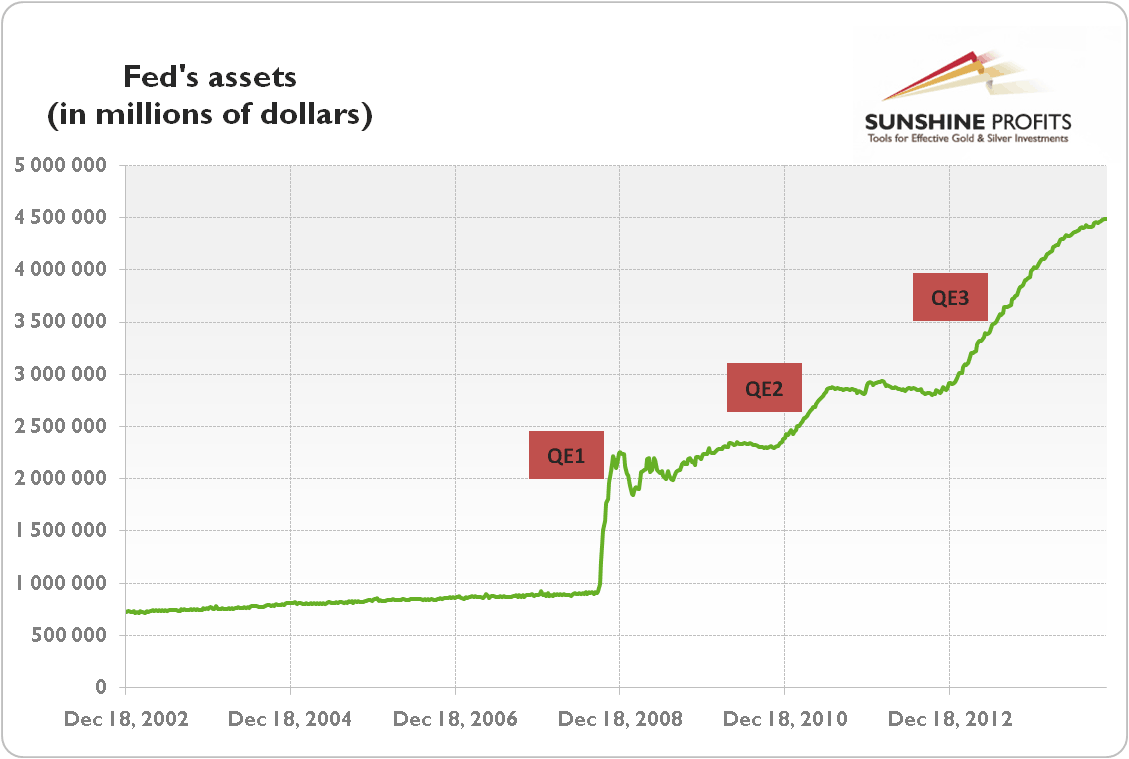
The quantitative easing was an unconventional monetary policy of buying financial assets from commercial banks. It increased the monetary base, Fed’s balance sheet and prices of purchased assets, decreasing their yields. The third, and for now the last, round of quantitative easing was announced on September 13, 2012 without stating the end date. Initially, the program involved purchases of agency mortgage-backed securities at a pace of $40 billion per month, but was extended to purchases of Treasuries involving $45 billion per month. In this largest asset-buying program, the Fed purchased assets worth around $1.6 trillion, expanding its balance sheet to about $4.5 trillion.
Graph 1: Fed’s assets (in millions of dollars) from 2002 to 2014
Theoretically, the halt of QE3 means the end of the multi-year asset purchases. However, not completely, because the “Committee is maintaining its existing policy of reinvesting principal payments from its holdings of agency debt and agency mortgage-backed securities in agency mortgage-backed securities and of rolling over maturing Treasury securities at auction,” as seen in the statement released by the Fed on October 29, 2014. It implies that although the Fed discontinued expanding its balance sheet, it will not allow it to shrink, at least for some time. And we are not talking about small amounts. According to Treasury Borrowing Advisory Committee estimates, if the Fed decides not to roll Treasuries (large amounts of them start maturing in 2016) over into new debt, the Treasury would be forced to borrow an extra $675 billion from the public over a three-year period. Therefore, the end of QE3 does not imply the end of quantitative easing. To use a metaphor, ending QE is not putting on the brakes; it is just easing off the accelerator.
However, even the complete reversal of QE3 would not mean the abandonment of the quantitative easing concept. The asset-buying program has become an established part of the Fed’s policy that could be implemented again in times of crises. Fed Chairwoman Janet Yellen has already said explicitly that she would not rule out more assets buying if needed. It is not coincidence that we have witnessed three rounds of the quantitative easing. We hope you remember that after the end of QE1 in March, 2010, there was a substantial correction in stocks (just under 20%), leading the U.S. central bank to start QE2. Then, after the halt of QE2 in June, 2012, there was another important stock market decline (about 20%), and that was the reason why the Fed launched the third round of QE. Given the fragile nature of the global economy, if asset prices fall or economic growth falters, we could witness QE4, especially since the Fed’s actions are data driven.
We focus on the U.S. central bank’s policy and its implications for the gold market in our monthly Market Overview reports and we invite you to check them out. We also provide Gold & Silver Trading Alerts for traders interested more in the short-term prospects. If you’re not ready to subscribe now, we still encourage you to join our gold newsletter. It’s free and you can unsubscribe in just a few clicks.

SILVER Elliott Wave Technical Analysis – 1st December, 2014

Lara Iriarte
Posted Dec 3, 2014

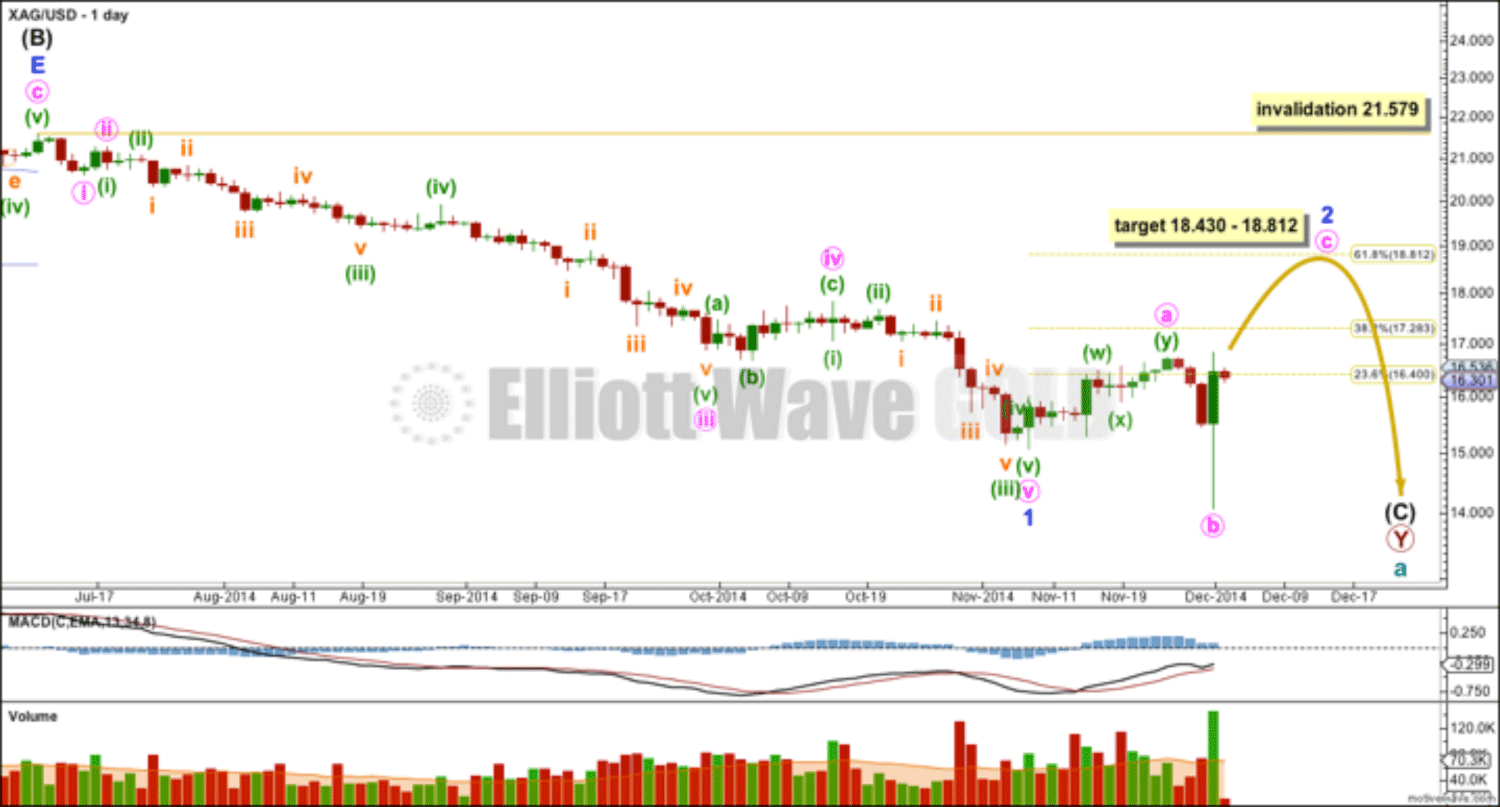
Downwards movement invalidated both daily Elliott wave counts, published two days ago. This Elliott wave count is updated and still expects upwards movement.
(Click on image to enlarge)
At 18.430 minute wave iii would reach 2.618 the length of minute wave i. This is close to the 0.618 Fibonacci ratio of minor wave 1 at 18.812. The target may be about two weeks away.