Sunday, 4 January 2015

Fed Abandons Stock Markets

Adam Hamilton
Archives
Jan 02, 2015

The seemingly-invincible US stock markets powered higher again last year, still directly fueled by the Fed's epic quantitative-easing money printing. But 2015 is shaping up to be radically different from the past couple years. The Fed effectively abandoned the stock markets when it terminated its bond buying late last year. So this year we will finally see if these lofty stock markets can remain afloat without the Fed.
Mainstream stock investors and speculators are certainly loving life these days. The flagship S&P 500 stock index enjoyed an excellent 2014, climbing 11.4%. And that followed 2013's massive and amazing 29.6% blast higher! The last couple years were truly extraordinary and record-breaking on many fronts, with the US stock markets essentially doing nothing but rally to an endless streak of new nominal record highs.
Such anomalously-one-sided stock markets naturally bred the extreme euphoria universally evident today. Greedy traders have totally forgotten the endlessly-cyclical nature of stock-market history, where bear markets always follow bulls. They've convinced themselves that these stock markets can keep on magically levitating indefinitely, that major selloffs of any magnitude are no longer a threat worth considering.
But extrapolating that incredible upside action of 2013 and 2014 into the future is supremely irrational, because its driver has vanished. The past couple years' mammoth stock-market rally was completely artificial, the product of central-bank market manipulation. The Federal Reserve not only created vast sums of new money out of thin air to monetize bonds, but it aggressively jawboned the stock markets higher.
Virtually every time the Fed made a decision, or its high officials opened their mouths, the implication was being made that it wouldn't tolerate any material stock-market selloff. The Fed kept saying that it was ready to ramp up quantitative easing if necessary. Stock traders understood this exactly the way the Fed intended, assuming the American central bank was effectively backstopping the US stock markets!
This short-circuited the normal and healthy way stock markets operate, cyclically. In normal times when stock traders grow too greedy and bid stocks up too high too fast, corrections periodically arrive. They drag overextended stocks back down, kindling fear and restoring critical sentiment balance. But with the Fed convincing stock traders it was ready to arrest any significant selling, they naturally lost all fear.
With the Fed printing money with reckless abandon, every minor stock-market dip was quickly bought. But with no significant selloffs to rebalance sentiment, greed flourished out of control. That eventually forced the stock markets to today's immensely overextended and overvalued levels, which stock-market history shows are exceedingly dangerous. The Fed distortion in these markets is extreme beyond belief.
And it has to end badly. The material selloffs in ongoing bull markets that the Fed foolishly chose to suppress keep sentiment balanced. They prevent greed from growing so extreme that it sucks in too much near-future buying. If euphoria pulls enough buying forward, there aren't enough new buyers left to continue propelling the bull higher so it collapses under its own weight. We're reaching that point.
Wildfires are a fantastic analogy. The longer a forest grows without suffering any significant fires to clear out flammable underbrush, the greater the conflagration when some wildfire inevitably erupts. Fire-suppression efforts, however noble, simply ensure the wildfire fuel sources will balloon to dangerous proportions. Stock markets are like the forest, and periodic corrections are like smaller fires that burn away fuel.
By aggressively inflating its balance sheet through money printing, the Fed artificially suppressed all the normal healthy stock-market selloffs that should have rebalanced sentiment. But back in late October, it ended its latest QE3 bond-monetizing campaign. And with this new year ushering in a new Congress dominated by anti-Fed Republicans, it is politically impossible for the Fed to launch any kind of QE4.
So the Fed's wildly-unprecedented balance-sheet growth of recent years is over. 2015 will actually be the first year since 2007 without any quantitative easing! And as this stacked chart of the Fed's balance sheet shows, a year without monetizing bonds is going to be a big shock to stock traders. Orange is the total balance sheet, red is monetized US Treasuries, and yellow shows the Fed's mortgage-backed securities.
Today's stock-market mess began with 2008's epic once-in-a-century stock panic. In its dark heart that October, the benchmark S&P 500 stock index (SPX) plummeted a sickening 30.0% in a single month! The Fed, fully realizing stock-market levels exert a huge influence over national economic activity, panicked. It slashed interest rates to zero in December 2008, and started printing money hand over fist to buy bonds.
In the first 8 months of 2008 before that stock panic, the Fed's balance sheet averaged $875b. But by the end of 2008, it had skyrocketed 154% higher to $2218b. Once it put its foot on the money-printing pedal, the Fed was terrified of letting off. So it converted its temporary QE buying during the stock panic to quasi-permanent holdings of US Treasuries and MBS bonds. This helped its balance sheet keep on ballooning.
QE1's debt monetizations were born, and soon expanded. After its pre-announced buying fully ran its course, the Fed followed the same pattern in QE2 and the so-called Operation Twist. That campaign shifted Fed capital from short-term Treasuries to longer-term ones in an attempt to manipulate interest rates lower. And finally QE3 came along, which proved far different from those other QE campaigns before it.
QE1, QE2, and Twist, despite their expansions, all had pre-announced levels of Fed money printing and debt monetization. But QE3 didn't. QE3 was totally open-ended, which was wildly unprecedented. With no pre-determined limit, the psychological impact of QE3 on stock traders was vastly greater. The Fed kept implying it was ready to expand QE3 anytime if stock markets needed help, and traders believed it.
The cyclical stock bull following the preceding cyclical bear climaxing in 2008's stock panic was totally righteous before QE3 came along in late 2012. Between the March 2009 cyclical-bear bottom and early September 2012 before the Fed announced QE3, the SPX powered 112.5% higher over 42 months. This was right in line with average mid-secular-bear cyclical-bull precedent of a doubling in 35 months.
The Fed's balance sheet was flat in 2009 as it shifted temporary stock-panic QE into enormous MBS and Treasury purchases. The SPX rallied 23.5% higher that year, which is totally expected after a panic-grade selloff. Then in 2010 when the Fed birthed QE2 which initially just converted MBS holdings into Treasuries, its balance sheet grew 9%. And the SPX's strong gains tapered off to a more normal 12.8%.
But in late 2010, QE2 was effectively tripled to include massive new Treasury buying. And most of that happened the following year, which led the Fed's balance sheet to balloon by 21% in 2011. Yet despite that, the SPX was dead flat and looking increasingly toppy in early 2012. So in September that year, the Fed birthed the unprecedented open-ended QE3. This was subsequently more than doubled shortly later in December.
Since QE3 didn't ramp up to full speed until early 2013, the Fed's balance sheet was flat in 2012. Yet the SPX was still able to muster a 13.4% gain on a still-normal-yet-maturing cyclical bull market. Up until about SPX 1500 in early 2013, the stock-market gains from the early-2009 bear-market lows were totally righteous. The Fed's extreme QE3 distortions began to manifest in early 2013, and have greatly worsened since.
2013 was the only full year of QE3, and it witnessed incredible monetary inflation as you can see in the chart above. That year the Fed's balance sheet rocketed up by a staggering 38%! That was its biggest percentage increase by far since that 2008 stock-panic year. And in absolute terms, 2013's $1107b of Fed balance-sheet expansion nearly rivals 2008's crisis $1345b! 2013 was an exceedingly-anomalous year.
That gargantuan money printing, and the associated Fed jawboning about backstopping stock markets, catapulted the SPX 29.6% higher in 2013! The correlation between the soaring stock markets and the soaring Fed balance sheet was nearly perfect, as the next chart below reveals. The vast sums of money the Fed was creating out of thin air to monetize debt were effectively finding their way into the stock markets!
The Fed started to wind down QE3's new buying in 2014, which reduced its balance-sheet growth to a 12% pace. But starting from such supremely-inflated levels, that was still another $486b of new money conjured from nothing! And there's no doubt 2014's still-massive monetary expansion was the primary driver of last year's strong 11.4% SPX up year. The Fed goosed the stock markets in 2013 and 2014.
But even this hyper-dovish Keynesian Fed gradually realized it can't print hundreds of billions of new dollars a year forever and not trigger massive and serious inflation. So it finally shut down QE3's new buying in recent months, although it still plans to roll over money from maturing bonds. In the relatively-short 6.3-year span between late 2008 and today, the Fed has more than quintupled its balance sheet to $4472b!
To put that into perspective, the Fed started publishing its balance-sheet total in November 1990. In the 17.8 years between then and the dawn of late 2008's stock panic, the Fed's balance sheet merely grew by 3.1x. Compare that to the 5.1x in the QE era since then which is only just over a third as long! There has never been a remotely comparable extreme period of new money created in the Fed's entire 101-year history.
And while all that inflation didn't filter down to normal Americans and catapult general price levels higher, yet at least, it did deluge into the US stock markets. This next chart is incredibly damning, and reveals the terrible problem the stock markets face in 2015. When the SPX is overlaid on top of the Fed's balance sheet, the correlation is incredibly high. Without more Fed inflation, these stock markets are in serious trouble.
Even though the cyclical stock bull between early 2009 and late 2012 was righteous, the powerful SPX advance still mirrored the Fed's balance sheet remarkably well. When the Fed was printing money to buy Treasuries, ramping up its total holdings, the SPX surged higher. But whenever the Fed's balance sheet merely stalled out, first between QE1 and QE2 and later between QE2 and Twist, the SPX corrected hard.
Provocatively the only two full-blown corrections, 10%+ selloffs, of this entire cyclical bull happened when the Fed's balance sheet stopped growing in mid-2010 and mid-2011. The SPX corrected 16.0% in 2.3 months in the first one, and 19.4% in 5.2 months in the second. Those are enormous selloffs by the standards of the past couple years, when the Fed's extraordinary QE3 stock-market levitation was in force.
Since the Fed birthed QE3 in late 2012 right before that year's critical US elections, there have been no correction-magnitude selloffs. The extremely-greedy popular sentiment fomented by the Fed has never been rebalanced away, like tinder-dry undergrowth in a forest. The biggest pullback of the past couple years' Fed-driven levitation is merely 7.4% climaxing in October 2014, which was far too small to do any real good.
In normal healthy bull markets, correction-magnitude selloffs erupt about once a year or so on average. As of the latest SPX nominal record high this week, it has been an astounding 39 months since the end of the last correction! The Fed's implied backstop for the stock markets through QE3 is solely to blame for this extreme anomaly. Such a long sans-correction span in such lofty euphoric markets is a recipe for disaster.
If the Fed hadn't effectively suppressed any stock-market selloff serious enough to bleed away greed and kindle some real fear, things would look far different today. The stock markets would be nowhere near as high, and today's universal euphoria would be far less extreme. Like those wildfires, the longer that correction-magnitude selloffs are suppressed, the bigger and meaner the inevitable rebalancing one will be.
The already-mature stock-market cyclical bull was in the process of topping in 2012 before the Fed chose to goose the stock markets with its unprecedented open-ended QE3. Ever since then, the SPX's advance has been super-highly-correlated with the Fed's balance sheet. A nearly-ironclad argument can be made that everything since 1500 in the SPX in early 2013 was nothing but Fed-blown hot air.
Stock-market valuations reveal that the great majority of the past couple years' extraordinary SPX rally was the result of multiple expansion, not higher earnings. Stocks were not bid higher because their underlying corporations were earning larger profits relative to their share prices, but due to the Fed's strong psychological incentives to buy high in a surreal correction-less market. Those have now vanished.
While the Fed announced the end of QE3 in late October, its balance sheet has still grown gradually since. The fact the stock markets haven't corrected yet has led many bulls to believe the end of QE3 is no threat to the euphoric stock markets. But history certainly doesn't support that cavalier dismissal of the post-QE3 risks. The last stock-market corrections in 2010 and 2011 erupted when the balance sheet started retreating.
That's on the verge of happening again today for the first time since 2012, before the QE3 levitation. Although the Fed has pledged to keep rolling over QE-purchased bonds into new ones as they mature, there is bound to be some modest balance-sheet shrinkage for technical reasons. And it will be very interesting to see if the stock markets can continue rallying when that happens, as history argues they likely can't.
Without QE or even the prospect of QE in 2015, the Fed's implied backstop for the US stock markets no longer exists. Sooner or later some selling catalyst will arrive, probably out of Europe like back in 2010 and 2011. And as investors and speculators start to exit stocks, that selling will cascade as there will be insufficient quick buy-the-dip capital inflows with the Fed no longer actively convincing traders to flood back in.
And the Fed abandoning the stock markets in 2015 with QE's new buying gone is only part of the big Fed-driven risks these lofty overvalued stock markets now face. Sooner or later the bond markets are going to force the Fed's hand in hiking interest rates from zero, where they've remained continuously since those temporary crisis levels were imposed in late 2008. Rising rates are super-risky for expensive stock markets.
And make no mistake, the SPX is very expensive today with its 500 elite component stocks trading at an average trailing-twelve-month P/E ratio of 25.1x late last month! Historical fair value is just 14x, far below current Fed-inflated levels. Today's very expensive valuation multiples are the result of both the Fed's QE3 stock-market levitation and manipulated artificially-low interest rates. Rate hikes will change everything.
As rates rise, overvalued stocks are hammered on multiple fronts. Rising rates make bonds relatively more attractive, so conservative investors sell overpriced stocks to return to bonds. And rising rates also directly hit profits, making stocks look even more expensive. They increase borrowing costs at the same time they retard sales as companies' customers are forced to cut back on their own spending. So stocks get hit hard.
Thanks to the Fed, the SPX's cyclical bull has soared an astonishing 209.0% higher over 5.8 years, far beyond historical averages. This propelled the stock markets to their highest nominal levels since their last secular bull peaked in early 2000. And couple that with stocks priced near 25x earnings, not far from the 28x historical bubble level, and rising rates along with a shrinking Fed balance sheet is a huge problem.
The last time the Fed raised its main federal-funds rate was way back in June 2006. So 2015 will be the first time in about 9 years that the stock markets have had to deal with rate hikes, right at the time they are the highest and most vulnerable. The smart bet to make in such a scenario is certainly the contrarian one, that no QE, a shrinking Fed balance sheet, and higher rates are going to lead to major stock selling this year.
The euphoric bulls won't even entertain that possibility, another topping indicator. They claim QE was a wild success and now the US stock markets can keep on powering higher indefinitely without the Fed. But there's a fatal flaw in this argument, QE and the associated zero-interest-rate policy remain far from over. No one knows the true impact of QE until the Fed has fully normalized its balance sheet and interest rates!
Until QE is totally unwound, which means the Fed's balance sheet returns to that $875b level where it was before 2008's stock panic, QE isn't over. And even though uber-dove Janet Yellen has promised never to return to those levels, the Fed's balance sheet still has to shrink dramatically from today's crazy extremes. And the normalization on the interest-rate front is every bit as extreme and dangerous for stock markets.
In the quarter-century between the early 1980s rate spike and 2008's stock panic, the federal-funds rate averaged 5.3%! So interest rates aren't normalized in the post-ZIRP era until they return to such high levels by recent standards. Traders have no idea if these Fed-inflated stock markets can stand on their own feet until the Fed's balance sheet shrinks back to $875b and the Fed's key federal-funds rate soars over 5%!
So prudent investors and speculators need to be exceedingly careful in 2015. The extreme stock-market rally of the last couple years was the product of Fed manipulation, and those gale-force tailwinds are now reversing into howling headwinds for the stock markets. Without the Fed's implied backstop that was such a powerful psychological motivator for traders in recent years, 2015 is going to prove a far-different ballgame.
With such an epic inflection point, traders have never needed a studied contrarian perspective on the markets more than today. That's what we specialize in at Zeal, where we've long walked the contrarian walk. We buy low when others are afraid, to later sell high when others are brave. And stock investors today have rarely been braver, as evidenced by their extreme euphoria and endlessly bullish outlook for 2015.
We've long published acclaimed weekly and monthly contrarian newsletters to help speculators and investors thrive. They draw on our decades of hard-won experience, knowledge, wisdom, and ongoing research to explain what's going on in the markets, why, and how to trade them with specific stocks. With a massive reversal brewing in these lofty stock markets, subscribe today before the damage is done!
The bottom line is the Fed has abandoned the stock markets. The powerful rallies of 2013 and 2014 were driven by extreme Fed money printing to buy up bonds. But with QE3's new buying terminated and any QE4 a political impossibility with the new Republican Congress, 2015 is going to look vastly different. A shrinking Fed balance sheet sparked major corrections even from far lower and cheaper stock levels.
With the Fed's balance sheet and zeroed interest rates finally starting to normalize in 2015, the lofty and overvalued Fed-levitated stock markets are in for some tough sledding. The implied backstop that enticed and forced so many traders to over-deploy in the stock markets in recent years has vanished. And the serious gravity of the Fed's absence will become readily apparent once the next selloff starts cascading.
###
Jan 02, 2015
Adam Hamilton, CPA

The Gold Owner's Guide to 2015
by Michael J. Kosares
Looking back - Two surprise transformations at the end of 2014
A year of many surprises, 2014 ended with a couple surprise personal transformations largely passed over by the mainstream media.
– Berkshire Hathaway chairman Warren Buffett startled recipients of his annual shareholder letter by revealing an instruction to the trustee for his wife's estate that 10% of her inheritance should be invested in government bonds and the other 90% in a low-cost S&P 500 index fund.
– Similarly former Fed chairman Alan Greenspan shocked the financial world by announcing that his years at the Federal Reserve cemented his long-held view of gold as an important asset allocation for the times given governments' (note the plural) predilection to print money.
Buffett points to saving fees and the inability of fund managers to beat the indices as the chief reasons for his decision, but one wonders if there might be more to it than that. Since the 2008 meltdown and the subsequent bailouts things have changed considerably on Wall Street and at the Federal Reserve. Interest Rate Observer's James Grant attempted to define the complicated change in the stock market's monetary underpinnings in a speech this past November before the Cato Institute.
"My generation," he said, "gave former tenured economics professors discretionary authority to fabricate money and to fix interest rates. We put the cart of asset prices before the horse of enterprise. We entertained the fantasy that high asset prices made for prosperity, rather than the other way around. We actually worked to foster inflation, which we called 'price stability' (this was on the eve of the hyperinflation of 2017). We seem to have miscalculated."
Stocks in this scenario become fungible, an asset class driven as much by monetary policy as it is a solid track record or growing market share. In the end, Buffett is not just saving fees by putting his wife's inheritance in index funds, he is also betting, like it or not, on the Federal Reserve's ability to keep stocks as an asset class headed in a northerly direction. Not everyone harbors the same high degree of confidence in the Fed's grand monetary experiment that Buffett does.
Alan Greenspan, for one, sees it as fraught with danger as does another former Fed chairman, Paul Volcker. Late last year, Greenspan likened the Fed's over-blown balance sheet to "a tinder box that has not been lit," characterized the job of Fed chairman as one subject to the heavy dictate of the federal government, and recommended gold ownership as a hedge for private investors. "Gold," he said, "is a good place to put money these days given its value as a currency outside of the policies conducted by governments." Stocks, on the other hand, have taken a position at the opposite end of the investment spectrum – an asset class that has become overly reliant on the policies conducted by governrment.
stocks, gold
Looking ahead - Much food for thought on gold and the economy for 2015
At the start of 2015, armchair economist-gold owners like Mr. Spot -- pictured below in his study -- remain content, confident and assured this New Year's Eve. He does not own gold simply to make profit. He owns it to protect the wealth he has already garnered. He keeps in mind the historical cycle described by Alexander Tyler, the 18th century historian and jurist:
"A democracy cannot exist as a permanent form of government. It can only exist until the voters discover that they can vote themselves money from the public treasury. From that moment on the majority always votes for the candidates promising the most money from the public treasury, with the result that a democracy always collapses over loose fiscal policy followed by a dictatorship. The average age of the world's great civilizations has been two hundred years. These nations have progressed through the following sequence: from bondage to spiritual faith, from spiritual faith to great courage, from courage to liberty, from liberty to abundance, from abundance to selfishness, from selfishness to complacency from complacency to apathy, from apathy to dependency, from dependency back to bondage."
spot2015He judges that we are now somewhere between the "selfishness" and "dependency" stages of Tyler's cycle, hopes that things will turn around, but keeps his diversification intact just in case it does not. The politicians, he observes, have not acted well this past year. Washington, he says, seems to be confused and lacking direction and more interested, as Tyler suggests, in getting re-elected than making responsible decisions about the future of the country.
He points to Neil Howe's conclusion that the Fourth Turning started with the 2008 financial meltdown and that we are likely to be in a transition period for some time to come. He takes Howe's observation to heart: "You are not just into it and out of it immediately. . .It is a season you have to move through before you are born again, so to speak, as a society, and regain institutional confidence. You have go through the crucible to get there."
(Editor's Note: Those of you who have followed my writings over the years know that I consider “The Fourth Turning” (1997) by William Strauss and Neil Howe one of the most important books published over the past two decades.  In that book, eleven years before the 2008 meltdown, the authors made one of the most stunning calls of all-time: “The next Fourth Turning,” they predicted, “is due to begin shortly after the new millennium, midway through the Oh-Oh decade. Around the year 2005, a sudden spark will catalyze a Crisis mood. Remnants of the old social order will disintegrate. Political and economic trust will implode. Real hardship will beset the land, with severe distress that could involve questions of class, race, nation, and empire.”)
Ever the amateur historian, Mr. Spot takes special note of the drain of Western gold to the East through the London-Zurich-Hong Kong-Shanghai pipeline. He is aware that a drain of gold from declining cultures to rising cultures usually accompanies the end phases of Tyler's cycle. Gold, he recalls, fled Rome just before the empire collapsed in the third century A.D. and the British Empire began to lose gold following World War I. Though he does not believe the end is nigh, he does believe that gold movements on this scale proceed for good reason. Many years ago, he tacked a sign on the bulletin board above his desk. It reads: "He who owns the gold makes the rules."
Like just about everyone else, he enjoys the end of year prediction festivities but he points out that almost all forecasting is necessarily based on trends already in motion. What foreasting inevitably fails to embrace is the surprise event, or even the surprise policy, launched by one government/central bank or another. He has structured his portfolio as a philosopher/investor not as a trend chaser. At a dinner party recently he caused some discomfort among an erudite group of analysts by asking how many predicted Russia's invasion of Crimea, the crash in oil prices or the rise of the Islamic State in Syria and Iraq.
We provided Mr. Spot with an advance copy of The Gold Owner's Guide to 2015. In appreciation he sent over the IPhone snapshot posted above and an encouraging note:
"I wholeheartedly approve! The 2015 Guide is even better than last year's."
And so, dear reader, we send you along to our annual catalog of opinion and predictions posted below with our own fondest wishes for a very happy and prosperous 2015.
We shall start with recent predictions posted by the big global trading banks -- the bulls and bears of gold finance.

Thursday, 1 January 2015

December 29, 2014

While oil prices have been volatile in 2014, stock prices haven't. The U.S. stock market has continued the gradual upward move it began in 2009, while the volatility index (VIX) peaked very briefly in October at 31, far below the level of almost 90 touched in 2008. Politics have been turbulent, and the oil-price decline has been significant by any standard, but equity investors have enjoyed a tranquil and prosperous year. It’s the latest of several years in which price changes have been gradual and generally upward and market and economic changes have been slow. For a number of reasons, 2015 promises to be very different and to see the return of fast markets, in which trading speeds up, prices jump all over the place and volatility spikes. For retail investors, it won't be an enjoyable experience.


"Fast markets” is a term used by the New York Stock Exchange (NYSE) and other markets to define market situations in which price discovery is impossible because trading is too chaotic. For example, NASDAQ defines it as "excessively rapid trading in a specific security that causes a delay in the electronic updating of its last sale and market conditions, particularly in options." You'd think fast markets would become impossible with electronic reporting, but as we saw during the 2010 "flash crash," electronic systems can themselves generate a volume of orders that overwhelms the normal market-making mechanisms and causes prices to leap about uncontrollably.

The term "fast markets” is relatively new, I believe dating back only to the 1990s, but the reality is a century old. During the "Black Tuesday" trading of Oct. 29, 1929—when a then-record 16 million shares changed hands on the NYSE—the electro-mechanical ticker tape ran fully six hours late. It was thus impossible for any investor not present on the floor of the Exchange to know at what prices shares were being dealt. The same phenomenon occurred on Oct. 19 and 20, 1987, even with the much quicker electronic reporting available by that time. Although the delay never stretched beyond an hour-and-a-half, it was sufficient to cause panic among market-makers and send S&P 500 futures prices well on the way toward zero.

The fast-markets phenomenon is inexplicable under conventional market theories such as the Efficient Market Hypothesis. These assume that markets are Gaussian and that one day's trading is more or less like any other, except possibly for differences in "volatility," that magic number that explains all trading anomalies. However, while theoretically impossible under modern financial theory, fast markets occur with some frequency. The trading in those markets is different not just in volatility, but in nature from that in calmer periods. The best analogy is to the flow of water through a pipe. As fluid dynamicists know, it can change in nature with additional velocity, becoming turbulent instead of streamlined and obeying a very different set of dynamic equations.

In fast-markets periods trading is mathematically chaotic, price discovery is not well behaved, prices leap by arbitrarily large amounts and, while trading volumes are exceptionally large in general, trading can cease altogether for periods of time during which there is no price at which buyers and sellers can be matched.

During the six years since the 2008 financial crisis, fast-markets trading periods have been infrequent, occurring only when computer generated algorithms have destabilized the market, with no rationally assessable news event or valuation change behind them. In 2015, this is likely to change, and it is worth setting out why this change will probably occur this year.

First and most important, the cheap money policies pursued by Federal Reserve (Fed) chairs Ben Bernanke and Janet Yellen since 2008 (and by Alan Greenspan since 1995) have vastly increased the leverage in the U.S. economic system at the retail, corporate, financial and government levels.

Consequently, they have made the system much more unstable. A sustained period of tight money in 1994 (which, with a top interest rate of 6% and a duration of only a year, was mild indeed compared to Paul Volcker's tightening in 1979-82) produced severe pain only in Wall Street. But today such an equivalent period would cause a "house of cards" financial-markets collapse by reducing asset values throughout the system. Debts suddenly would become worthless, and valuations, which had appeared soundly based, would suddenly be perceived as built on sand.

Optimists will opine with considerable justification that no power of heaven or earth is going to make Janet Yellen increase interest rates except by the tiniest amounts, so a collapse of asset values across the entire economy is very unlikely. We may descend into hyperinflation—and we are undoubtedly year by year decapitalizing the U.S. economy and making it less productive and more unstable—but a full-scale credit crunch must be regarded as a low probability, black swan event.

However, higher interest rates are not at this stage necessary to produce fast markets. The decline in oil prices from $100 a barrel to just above $50 has weakened asset values throughout the U.S. shale, tar-sands and deep-sea drilling sectors. This in turn will cause an explosion of losses and negative cash flow in many corporations, some of them surprisingly far from the sectors that are apparently worst affected.

The steady rise in stock prices over the last six years has been fueled by earnings at a historically exceptional level in terms of Gross Domestic Produce (GDP), with prices further boosted by massive stock buybacks—$55 billion in 2014 by Apple alone. Unlike 1999, stock prices are not grossly inflated in relation to earnings. But earnings themselves are inflated, and leverage is boosted by the artificial stock repurchases, which certainly do not increase the stability and value of the underlying, over-leveraged companies.

Hence, anything that causes a dip in corporate earnings is likely to have a disproportionately severe effect on the market, as valuation metrics that had appeared reasonable in terms of inflated earnings become highly unreasonable as earnings revert to a more historically normal level. Again, the most likely catalyst for such a reversion is a rise in interest rates, but the current tsunami in the oil sector may well be sufficient to affect a necessary proportion of U.S. corporations as to topple the unsteady edifice of current valuation metrics.

Such a reversal looks increasingly likely. The five percent increase in third quarter GDP, fueled by increased consumer spending, is an example of how the benefits of lower oil prices are coming before the costs. However, in 2015 the costs will begin to appear, and profitability will be affected. This reflects the tapering off, as Chinese wages rise, of the massive benefits from globalization that have propped up the profits of U.S. multinationals. It can be expected to accelerate in 2015. At some point, even the doziest investors will notice.

However, beyond oil and corporate profits generally, the most likely catalyst of fast-markets trading in 2015 is a fall back to earth in the tech sector. Too many companies in that sector have decided they are above the vulgar necessity of actually earning a profit. This is not just a short-term phenomenon. Amazon has a market capitalization of $140 billion without ever having produced more than a marginal profit (its current trailing P/E is infinite, its forward P/E a relatively conservative 343 times earnings). And smaller companies such as Angie's List have managed to exist for almost two decades without making a profit at all.

At some point investors will stop buying dreams and start insisting on reality. With the turbulence to be expected elsewhere, it's likely that their belated realization—which may look rather like William Holman Hunt's 1853 masterpiece "The Awakening Conscience"—will take place in 2015. At that point, investors, realizing like Holman Hunt's mistress the true horror of their position, will see that without profits, there is nothing to support sky-high valuations, and market "volatility" will reappear with a vengeance.

Lengthy periods of prosperity can continue for a very long time if they are intrinsically stable. But the current upswing, in which stock-market valuations break new records while the economy moves ahead only sluggishly, is highly artificial. It is born of monetary, and to a lesser extent, fiscal policies of record-breaking profligacy. In 2015, reality is likely to dawn on investors, triggered by huge losses in the oil sector and the potential for huge losses in tech. The market will react accordingly. Fast markets will be a symptom of the new reality.
Upcoming 2015 year will be all about further moves towards the integration of Eurasia as the US is progressively squeezed out of Eurasia, Pepe Escobar believes.

BEIJING, December 31 (Sputnik) — Fasten your seatbelts; 2015 will be a whirlwind pitting China, Russia and Iran against what I have described as the Empire of Chaos.
So yes – it will be all about further moves towards the integration of Eurasia as the US is progressively squeezed out of Eurasia. We will see a complex geostrategic interplay progressively undermining the hegemony of the US dollar as a reserve currency and, most of all, the petrodollar. For all the immense challenges the Chinese face, all over Beijing it's easy to detect unmistakable signs of a self-assured, self-confident, fully emerged commercial superpower. President Xi Jinping and the current leadership will keep investing heavily in the urbanization drive and the fight against corruption, including at the highest levels of the Chinese Communist Party (CCP). Internationally, the Chinese will accelerate their overwhelming push for new 'Silk Roads' – both overland and maritime – which will underpin the long-term Chinese master strategy of unifying Eurasia with trade and commerce.
Global oil prices are bound to remain low. All bets are off on whether a nuclear deal will be reached by this summer between Iran and the P5+1. If sanctions (actually economic war) against Iran remain and continue to seriously hurt its economy, Tehran’s reaction will be firm, and will include even more integration with Asia, not the West.
No matter how it was engineered, the fact that stands is that the current financial/strategic oil price collapse is a direct attack against (who else?) Iran and Russia. 
Washington is well-aware that a comprehensive deal with Iran cannot be reached without Russia’s help. That would be the Obama administration’s sole – and I repeat – sole foreign policy success. A return to the “Bomb Iran” hysteria would only suit the proverbial usual (neo-con) suspects. Still, by no accident, both Iran and Russia are now subject to Western sanctions. No matter how it was engineered, the fact that stands is that the current financial/strategic oil price collapse is a direct attack against (who else?) Iran and Russia.
That derivative war
Now let’s take a look at Russian fundamentals. Russia’s government debt totals only 13.4% of its GDP. Its budget deficit in relation to GDP is only 0.5%.  If we assume a US GDP of $16.8 trillion (the figure for 2013), the US budget deficit totals 4% of GDP, versus 0.5% for Russia. The Fed is essentially a private corporation owned by regional US private banks, although it passes itself off as a state institution. US publicly held debt is equal to a whopping 74% of GDP in fiscal year 2014. Russia’s is only 13.4%. The declaration of economic war by the US and EU on Russia – via the run on the ruble and the oil derivative attack – was essentially a derivatives racket. Derivatives – in theory – may be multiplied to infinity. Derivative operators attacked both the ruble and oil prices in order to destroy the Russian economy. The problem is, the Russian economy is more soundly financed than America's.
Considering that this swift move was conceived as a checkmate, Moscow’s defensive strategy was not that bad. On the key energy front, the problem remains the West’s – not Russia’s. If the EU does not buy what Gazprom has to offer, it will collapse.
Moscow’s key mistake was to allow Russia's domestic industry to be financed by external, dollar-denominated debt. Talk about a monster debt trap  which can be easily manipulated by the West. The first step for Moscow should be to closely supervise its banks. Russian companies should borrow domestically and move to sell their assets abroad. Moscow should also consider implementing a system of currency controls so the basic interest rate can be brought down quickly.
And don’t forget that Russia can always deploy a moratorium on debt and interest, affecting over $600 billion. That would shake the entire world's banking system to the core. Talk about an undisguised “message” forcing the US/EU economic warfare to dissolve.
And don’t forget that Russia can always deploy a moratorium on debt and interest, affecting over $600 billion.
Russia does not need to import any raw materials. Russia can easily reverse-engineer virtually any imported technology if it needs to. Most of all, Russia can generate — from the sale of raw materials – enough credit in US dollars or euros. Russia's sale of its energy wealth — or sophisticated military gear — may decline. However, they will bring in the same amount of rubles — as the ruble has also declined.
Replacing imports with domestic Russian manufacturing makes total sense. There will be an inevitable “adjustment” phase – but that won’t take long. German car manufacturers, for instance, can no longer sell their cars in Russia due to the ruble's decline. This means they will have to relocate their factories to Russia. If they don’t, Asia – from South Korea to China — will blow them out of the market.
Bear and dragon on the prowl
© Flickr/ European Southern Observatory
The EU's declaration of economic war against Russia makes no sense whatsoever. Russia controls, directly or indirectly, most of the oil and natural gas between Russia and China: roughly 25% of the world's supply. The Middle East is bound to remain a mess. Africa is unstable. The EU is doing everything it can to cut itself off from its most stable supply of hydrocarbons, prompting Moscow to redirect energy to China and the rest of Asia. What a gift for Beijing – as it minimizes the alarm about the US Navy playing with "containment" across the high seas.  Still, an unspoken axiom in Beijing is that the Chinese remain extremely worried about an Empire of Chaos losing more and more control, and dictating the stormy terms of the relationship between the EU and Russia. The bottom line is that Beijing would never allow itself to be in a position where the US could interfere with China's energy imports – as was the case with Japan in July 1941 when the US declared war by imposing an oil embargo, cutting off 92% of Japanese oil imports.
Everyone knows a key plank of China’s spectacular surge in industrial power was the requirement for manufacturers to produce in China. If Russia did the same, its economy would be growing at a rate of over 5% per year in no time. It could grow even more if bank credit was tied only to productive investment.
Now imagine Russia and China jointly investing in a new gold, oil and natural resource-backed monetary union as a crucial alternative to the failed debt "democracy" model pushed by the Masters of the Universe on Wall Street, the Western central bank cartel, and neoliberal politicians. They would be showing the Global South that financing prosperity and improved standards of living by saddling future generations with debt was never meant to work in the first place.
Until then, a storm will be threatening our very lives – today and tomorrow. The Masters of the Universe/Washington combo won’t give up their strategy to make Russia a pariah state cut off from trade, the transfer of funds, banking and Western credit markets and thus prone to regime change.
Further on down the road, if all goes according to plan, their target will be (who else) China. And Beijing knows it. Meanwhile, expect a few bombshells to shake the EU to its foundations. Time may be running out – but for the EU, not Russia. Still, the overall trend won’t be altered; the Empire of Chaos is slowly but surely being squeezed out of Eurasia.
New Year Holiday Schedule
PennTrade
Jan 1, 2015


Dear PennTrader:

U.S. and Canadian markets will be closed on Thursday, January 1. So will we.

Both markets will reopen on Friday, January 2, and we will, too.

All of us at PennTrade wish you and yours a Happy, Healthy and Prosperous New Year.

Jan 2015

Wednesday, 31 December 2014

Dismal Year For Commodity Markets, Gold Neutral, Palladium Excels

By Neils Christensen of Kitco News
Wednesday December 31, 2014 10:12 AM
(Kitco News) - As traders and analysts look back on 2014 the one theme that most can agree on is that commodity markets had a terrible year, while the U.S. dollar shone bright.
“Overall it has been a dismal year for the commodity complex with 2014 registering the largest annual loss since the global financial crisis of 2008,” said Tim Gardiner, managing director of global metals at TD Securities, in a note to clients Wednesday.
Although commodities struggled through 2014, gold was a modest source of strength as it ends the year near neutral territory. As of 9:48 a.m. EST, Comex February gold futures were at $1,194.60 an ounce, down $6.40 on the day.
Gardiner said while gold appears to be ending the year where it started the price averaged $1,265 an ounce in 2014.
Analysts have noted that the biggest factor affecting commodity prices this year has been the U.S. dollar, which has had its best performance since 2015. The U.S. dollar has benefited from an outperforming economy and interest rate differentials. While the Federal Reserve is contemplating normalizing interest rates other major central banks like the European Central Bank and Bank of Japan continue to loosen their monetary policy.
Analysts at BNP Paribas said in a research note Wednesday that the U.S. dollar is ending the year with double digit gains, rising about 12% on the year. They added that they expect to see continued U.S. dollar strength in 2015.
“The rapidly disappearing excess capacity in the US economy should keep U.S. yields supported and continue to boost the USD in 2015,” they said in their note.
According to data compiled by Brown Brothers Harriman, the yellow metal was their second best performing commodity of the year.
In BBH’s list, Coffee found the top spot for 2014, seeing 48.6% returns on the year. At the bottom of the list is crude oil, which lost more than 49% on the year.
The silver market was caught in the middle as prices lost about 17% on year.
Peter Hug, global trading director at Kitco Metals, said that within the precious metals complex, palladium is “the last metal standing” for 2014. Palladium is ending the year in positive territory with gains of about 12% on the year.
“Economic growth in 2015 will continue to affect palladium supplies, along with rhodium, which is in a similar situation, both may be the metal stars of 2015,” he said.

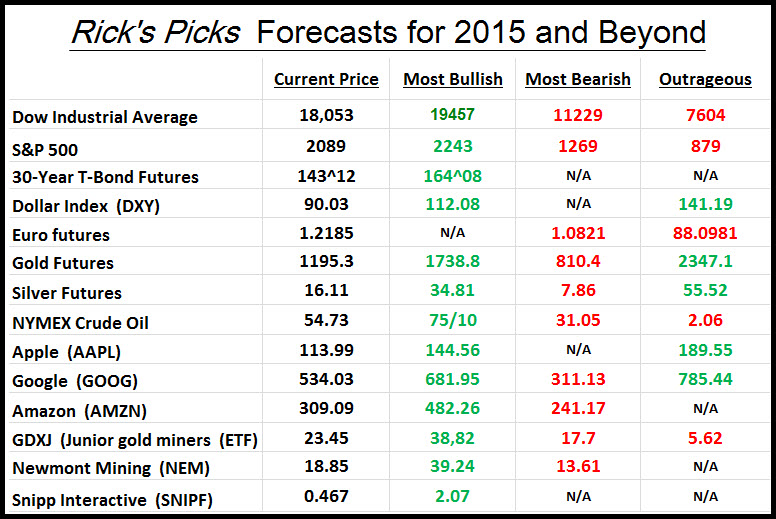
My Stock Predictions for 2015 and Beyond

by Rick Ackerman on December 29, 2014 12:32 am GMT · 11 comments
In the past, Rick’s Picks has shunned year-end predictions because there are far too many variables to handicap accurately. I’ve decided to take a crack at it anyway this year because I was curious to see what conclusions purely technical analysis would yield for some widely followed issues. I’m no seer, just a chartist, and I’ll say up front that the question of whether the Dow Industrials are trading at 23,000 at the end of 2015, or at 14,000, is probably no better than a coin-toss bet. Also, because the stock market is a house of cards and only distantly connected to economic reality, only a fool would try to predict the timing of The Big One that we all know is coming. Stocks could collapse at any moment, to be sure, and although I doubt this will occur next year, the odds are hardly remote. If you absolutely need to know when calamity will strike, I recommend checking the year-end predictions of Bob Prechter, Martin Armstrong and Ross Clark, since they are the very best timers in the guru world.
stock-predicitions-2015
Click here to share these stock predictions for 2015 on Twitter.
Keeping the foregoing in mind, I’ve allowed for both bullish and bearish scenarios in most of the forecasts above. Those designated ‘N/A’ imply outcomes that are unimaginable to me. For instance, the shares of Snipp Interactive, a penny stock that is my number one bullish pick for 2015, seem unlikely to head lower no matter what happens to the economy. The firm provides personal-device-based marketing solutions to a growing list of blue-chip clients, and they are nimble and imaginative enough not only to excel in their niche, but to expand it. Similarly, Apple looks like a surefire winner, especially with the company positioning itself via Apple Pay to take a small piece of every retail transaction that occurs. Indeed, if there is a good reason to think U.S. stocks will continue higher in 2015, it is that the shares of Apple, the most valuable company in the world, look so promising. I’ll mention T-Bonds as well. They were my no-brainer, shout-it-from-the-rooftops bull trade in 2014, producing capital gains of 20%-plus, and so they shall remain. I expect long-term Treasurys not only to continue their long-term uptrend and yields to continue falling in the year ahead, but for years to come.
Dow ‘Only’ to 19457?
Some final notes: Some of the bull/bear targets paired in the table above could both be hit, although not necessarily in the same year. That goes for bullion, where my forecast allows for a bull market to begin after a bottom is reached sometime next year. Obviously, the $2.06 target for a barrel of crude is an extreme outlier. I’ve included it simply because, strictly speaking, that’s what the charts indicate now that January Crude has fallen beneath a key ‘midpoint Hidden Pivot’ at 55.43. A rally back to that price would theoretically be short-able. Indeed, any target given above can be used in two ways: 1) getting long or short with the implied trend; and/or 2) playing for a reversal at the target itself.  Regarding the Dow, I was surprised myself to see that, from a purely technical standpoint, a mere 19457 would seem to be as bullish as it gets. You should jot down 18973 as well, since that Hidden Pivot also has the potential to reverse the bull’s nearly six-year rampage.

Sound Money and the Ring of Truth

Guy Christopher
Posted Dec 31, 2014

We Americans no longer carry gold and silver money in our pockets and purses as our grandparents did during their lives. But we still carry the history, legacy and spirit of those gold and silver coins in our language – with more meaning than you might imagine.
“Sound money” has a clear message recognized for centuries around the world. It describes the musical, metallic ring of a gold, silver, or copper coin dropped on any hard surface of glass, stone, wood, or metal. Sound money literally refers to real wealth, with a natural, unmistakable signature of honesty and integrity, as opposed to the swishy paper and plastic debt used almost exclusively today.
The term “sound money” is believed to come from Ancient Rome, where small silver coins were standard in everyday commerce, for paying Roman soldiers to buying exotic goods from all corners of the known world. As Rome squandered its wealth, it found what seemed an easy shortcut to shore up the treasury. It gradually debased those silver coins with common metals, ultimately cutting the silver content to just 5 percent.
But that didn't fool anyone for long, most of all disciplined Roman soldiers, who did not appreciate being paid with worthless mystery metal in return for risking their lives on Rome's bloody battlefields.
Do You Want True Money or a Debased Dud?
Not every Roman soldier had room in his gear for a touchstone, usually fieldstone or slate, also used to test the purity of metals. But they quickly discovered the difference in the sound of true money and a debased dud.
They recognized that real silver had a distinctive melodious ring when bounced on a hard surface, such as the blade of a handy sword, a bronze breastplate, or an ornate marble floor. Sound money carried the 'ring of truth,' while debased coinage landed with a dull, disappointing thud.
The debasement of Rome's silver currency unmasked the deceit of a bankrupt empire, which ended with the fall of Rome, a pattern repeated many times. Sound money's “ring of truth” had found its place in the history of money and of nations.
As the United States grew westward to the Pacific Coast and north to Alaska, gold, silver and copper coins of all nations were legal tender in the young United States until the 1850's, and were in use even long after that. Americans with no formal education in reading, writing and arithmetic relied on the sight, sound, and feel of the only money they knew. Learning the different musical ringing sounds of those coins could easily qualify even a prairie settler fresh off the wagon train as an economic expert.
In the Old West of the range roving American cowboy, the ring from that silver dollar tossed on the bar of polished oak told the saloon keeper he was pouring whiskey for sound money, and not for a counterfeit forgery.
The sound money test unmasked one of the most famous counterfeiting schemes in American coinage history. The Liberty Nickel (1883-1913) was originally struck without the words “Five Cents,” bearing instead only the Roman numeral “V.” Gold plated Liberty Nickels were passed off as a newly designed $5 gold piece, but the sound money test quickly identified the scandal. Within six months of issuing the first “V” nickels, the U.S. Mint added the words “Five Cents.” But for the next many years, every Liberty $5 Half Eagle in town was tested for its ring of truth.
Sound money means simplicity, honesty, and trustworthy recognition. It stands for strength and durability which were also characteristics of those pioneering Americans who built our nation.
The ring of sound money for centuries has transcended borders and nationalities by singing its own melodic language. No matter what words were stamped into a precious metal coin, that ring of sound money certified its value, or exposed the deception.
Governments Have Distorted the Meaning of Money
“Sound money” carries such a powerful message there's little wonder that governments issuing paper fiat currency have attempted to corrupt its meaning, with help from unimaginative and lazy educators and journalists.“Hard currency” first referred to metal coins, not paper money, but the term over the years has come to mean that flimsy, paper, folding cash is more trustworthy than a handwritten check or IOU.“Good as gold” is another aberration of “sound money,” usually referring to credit worthiness, even though there is no credit as good as gold.When Washington and Wall Street began pushing plastic credit cards, which are nothing more than debt disguised as wealth, Americans were introduced to the gold card along with the credit rating and FICO score as a false measure of one's financial worth. Today, the newest edition of the $100 Federal Reserve note carries a golden inkwell and feather pen, as if to sarcastically say money itself is a masquerade of paper script and not precious metal.Americans today have no memory of those times when gold, silver, and copper coins were tossed across a store counter, or counted out by hand, to pay for everything from penny candies to Ford Model-T automobiles. That era began ending when President Roosevelt in 1933 outlawed the use of gold coins in everyday American commerce.The separation of Americans from their Constitutional heritage to true money continued through 1964, with the end of small coinage containing 90% silver. The deception was complete by 1982 when copper quietly disappeared from the Lincoln penny.But no government could remove the ringing echo of sound money from history, or from us. And government cannot camouflage its counterfeits with gold colored paint. You can experience sound money's evident ring of truth for yourself. Toss any gold or silver coin on your kitchen table and you will hear the history of honest money ringing down through the centuries.

IT COULD NOT LOOK BETTER FOR THE PM SECTOR GOING INTO 2015...


originally published December 30th, 2014

In this article we are going to look at compelling evidence that the Precious Metals sector is either at or very close to a major bottom, and see why the chances are high that the sector will rally strongly in the New Year. You have all heard the old adages about “buying low and selling high” and how the time to buy is when there is “blood running in the streets”. Never have these adages been more applicable than they are now to the Precious Metals sector, where even the most diehard bulls have had enough and thrown in the towel.
The abysmal sentiment towards the sector is starkly illustrated by two of the indicators that we will now look at. The first of these charts shows the Gold Miners Bullish Percent Index, going back 7 years. On this chart we can see that only on two other occasions in the history of this indicator has sentiment towards gold stocks hit rock bottom at 0% as it has in recent weeks – once late in 2008 when the sector bottomed at the trough of the broad market crash and again in the middle of 2013, after which there was a rally before prices ran off sideways for over a year. When you get readings this low it basically means that there is no-one left to turn negative, and no-one left to sell. By itself this bodes well for the sector.

In further support of the contention that we are at or close to a major low is the 20-year chart for the ratio of the large stocks XAU index over gold which is at record low levels. The rationale behind this being bullish is simple to understand – when investors are fearful towards the sector and negative on it, they favor bullion over stocks, because they figure that while stocks can go to zero, bullion cannot, and they are right about that. What they are not right about is being fearful when everybody else is fearful – which means there’s no-one else left to get scared and sell, as is the case now. When this ratio is at a negative extreme as now, it means that the mob are extremely and universally negative – and that has to be bullish. Right now this ratio is at astoundingly low levels – way below the levels it was at late in 2000, right before the start of the great gold and silver bullmarket, and at the depths of the 2008 market crash – Precious Metals stocks have already crashed and are friendless.

Finally we have another powerful indication that the sector is bottoming in the volume pattern of junior mining stocks, expressed collectively in the form of the Market Vectors Junior Gold Miners ETF, GDXJ, whose 4-year chart is shown below. On this chart we can see that volume in GDXJ has ramped exponentially all this year to extreme levels, that must signify a bottom, because the sellers must by definition be “dumb” because they are obviously selling at a massive loss – so who is doing all the buying, taking the other side of the trade? – Smart Money, that’s who. The enormous recent volume in this is evidence of a massive transfer of stock from weak to strong hands, and since the new buyers are not going to sell until they have turned a profit, it is easy to understand that immediately an uptrend takes hold, new buyers are going to find no stock available and will have to drive prices sharply higher to get their orders filled.

Does this mean that most junior miners will survive? – sadly, it doesn’t – hundreds of junior mining companies can be expected to fail next year – it’s too late for rising stock prices to save many of them. What the volume in GDXJ is telling us is that Smart Money is looking beyond the cull to the New Dawn that will follow, when the better junior miners, especially those that are in production or close to going into production, will reap the benefits of having hunkered down and pulled through a very difficult time, which will be magnified by the extra savings resulting from low oil prices, with fuel being a major component of mining industry costs.
The worries about deflation dragging the sector further into the mud are a “red herring” – gold does well during deflationary times as old timers like Richard Russell will recall from the experience of the 30’s. So if we do see deflation, it should not prove to be a problem for the sector.
Finally, end of year tax loss selling will be over this week, so we are at a good point for a sector rally to start, as was the case last year.
The conclusion to all this is that we appear to be at an excellent point to buy the better mining stocks, and you shouldn’t have to wait too long before investments in the sector start to pay off.

When Fearmongering Goes Bad: Greece Scrambles To Prevent Deposit Run Goldman Warned About In Its "Worst Case"

Earlier today we got a classic, if rare, example of what happens when bankers bluff with a 2-7 off suit... and the people call it.
Recall that just over two weeks ago, none other than Greek currency swap expert Goldman (alongside Jean-Claude Juncker who quite explicitly warned Greeks not "to vote wrong") came out with a fire and brimstone worst-case scenario for Greece, which was nothing but an attempt at fearmongering designed to scare Greek MPs into doing Samaras' bidding, in which it said not electing the designated presidential candidate may lead to a worst-case scenario which involves a "Cyprus-style prolonged bank holiday."
For those who have forgotten, these were the salient points from Goldman:
In the event that the parliament fails to elect a president, general elections would be held and market uncertainty/pressures would extend. At this stage it is important to understand that market pressures are not linked to the democratic process of elections nor to a potential government change, whatever the ensuing government formation may be. They are linked to the risk of policy discontinuity and a severe clash between Greece and international lenders. More specifically, we think the room for Greece to meaningfully backtrack from the reforms that have already been implemented is very limited. Any such attempt would lead to an interruption of official financing to Greece.

Examining the downside scenario.

To be sure, even in the event of a government change, there is room for a cooperative solution between Greece and Europe. Greece has made significant reform progress between 2012 and the gap between what has already been implemented and what remains to be done is not insurmountable.

Also, the incentives for a clash are not there. For instance any Greek government would likely want to capitalize on the momentum that the economy is building on the activity front, rather than trigger a disruptive capital flight that would lead Greece to a double–dip recession. In addition, given that more than 80% of Greek debt is held by the official sector and given that any OSI would be feasible only as part of an agreement with the Euro-area, there is an incentive for a Greek government to pursue cooperative solutions.

However, the history of the Euro-area crisis has shown that the probability of an “accident” can never be dismissed, when it comes to intra-EMU politics. And it is important for markets to be able to understand and quantify the aspects of a potential downside scenario, where official financing to Greece is interrupted.

The Biggest Risk is an Interruption of the Funding of Greek Banks by The ECB.

Pressing as the government refinancing schedule may look on the surface, it is unlikely to become a real issue as long as the ECB stands behind the Greek banking system. In fact, refinancing became a lot more pressing between 2011 and 2012. But financing needs were met despite the impasse in negotiations between Greece and international lenders – partly via the issuance of T-bills repoable at the ECB by Greek banks. Such methods can always be revisited at times of extreme need.

But herein lies the main risk for Greece. The economy needs the only lender of last resort to the banking system to maintain ample provision of liquidity. And this is not just because banks may require resources to help reduce future refinancing risks for the sovereign. But also because banks are already reliant on government issued or government guaranteed securities to maintain the current levels of liquidity constant.

And this risk can become more pressing from a timing perspective. At the heat of the Greek crisis, there was evident deposit and broader capital flight, which Greek banks helped accommodate with ECB’s help via the ELA facility. In the event of a severe Greek government clash with international lenders, interruption of liquidity provision to Greek banks by the ECB could potentially even lead to a Cyprus-style prolonged “bank holiday”. And market fears for potential Euro-exit risks could rise at that point.
Stripping all the political correctness, what Goldman said is that unless Greece quickly folds back in line and does as unelected Brussels eurocrats demand, there may well be a Cyprus-style bank closure coupled with preemptied bank runs.
Oops. Because if that was the doubled-down bluff, then Greece just called it, and the "downside scenario" is now in play.
Which means Greece now has to scramble to avoid precisely what Goldman warned would happen if the Greeks dared to put their (meagre) savings at risk. And, case in point, here is the Greek finance minister rushing to squash the next steps, which - as Goldman so conveniently explained - involve potential bank runs, a potential bank holiday, and potential Cyprusing of the financial system, only this time it is not Russian oligarchs who are most exposed - they have learned their lessons by now - by ordinary Greeks.
Here is Newsbomb.gr with what is sure to be an amusing backtracking on all the fearmongering that had been unleashed previously.
The government has guaranteed that bank accounts are safe and legislated deposit safeguards in the event of a shakeup ahead of Monday's parliamentary election for Greek president, Finance Minister Gikas Hardouvelis said in an interview on Sunday's Vima.

Hardouvelis was speaking ahead of the third and last attempt by this Parliament to elect a Greek president that will held on Monday, December 29. Failure to elect one
"We are preparing to withstand any rolling and pitching. We have already passed laws safeguarding bank deposits, and are in constant touch with our EU fellow-members, while the whole government will be on alert and vigilant," Hardouvelis said.

Hardouvelis said that Greece must continue "to the next stage, which will be based on our growth plan, under our own initiative, without coercion by the troika of Greece's lenders."

Speaking of "bank deposits, which are safe," he said his ministry had "taken care this past week and legislated the option of the Hellenic Financial Stability Fund's to lend money to the Hellenic Deposit and Investment Guarantee Fund if it needs greater reserves than those available to support depositors."

Asked whether he thought that a new government might be elected with a stance hostile to the memorandum, the finance minister replied, "The key to avoid tossing and turning and our economy's future in 2015 and later is held by the European Central Bank... This key can easily and abruptly be used to block funding to banks and therefore strangle the Greek economy in no time at all."
Actually no.
The ECB's hands are tied right now, because the last thing Mario Draghi can do is proceed with open monetization of peripheral bonds (which would have to be purchased in any ECB public QE alongside all other Eurozone bonds) at a time when Greece can pull the rug from under the ECB's already massive holdings of Greek public debt, and enforce a haircut which would impair the ECB's balance sheet, in the process costing Mario Draghi his job and a handing the victory to the "sound money" Bundesbank on a silver platter.
Worse, should Greece decide to default it would means those several hundred billion Greek bonds currently held in official accounts would go from par to worthless overnight, leading to massive unaccounted for impairments on Europe's pristine balance sheets, which also confirms that Greece once again has all the negotiating leverage.
So with the ECB out of the picture, and with the ball in Greece's court, it actually makes the situation that much more unstable, and indeed could be just the precursor to the "Cyprus-style bank holiday" that Goldman warned about.
How credible will this warning be in practical terms over the next month as Greece prepares for a historic election? Keep an eye on those lines in front of ATMs, because unlike Cyprus, at least the Greeks still have access to Euros. The question is will they pull out enough Euros before their only currency option in front of the ATM is New Drachmas?