Monday, 29 December 2014


2014 - A Breakthrough Year for Technology Metals

It is impossible to create a connected, mobile and sustainable society without technology metals (precious metals, specialty metals and rare earth elements) enabling it. Lithium stores energy in our rechargeable batteries; neodymium's magnetic properties run electric motors of which there are many in our lives; silver helps collect sunlight and turn it into renewable energy. Tech Metals Insider reported about these and many other applications throughout the year.

Volatile Blahs

Equities were up a small amount today amid cautious holiday trading, but the U.S. dollar continued its climb to supremacy, helping push gold lower. But the dollar doesn’t tell the whole story today for gold.
The chief outside market influence, crude oil, was down severely again, by around 2%. Gold was dragged down on that ride.
Thin trading also did not help gold, as a few major sales going into year’s end forced prices down. Investors are squaring up their books, taking their losses (or gains if the case might be), and exiting positions all over the place, except for equities, which, of course are much less volatile than commodities markets, trading, as they do, in factors rather than simple dollar gain and loss like stocks.
The news of Greek’s renewed shakiness wasn’t enough to goose gold upward. Most analysts, including us at the Gold Forecast, feel that Greece is a lost cause and it is already factored in to prices of various financial instruments. Greece may continue to harm the euro, which doesn’t seem to need any help with that currently. A sinking euro lowers gold prices in dollars.
Some support was seen in physical gold as we approach the Chinese Lunar New Year, a favorite time for buying in the huge country. Other than that, consumption of the actual metal is soft.
While technical support was threatened today, the decline in gold didn’t crash through our previously delineated levels - more on that in Market Forecast.
As might be expected at this time of year, international news is slow so there were no big new factors that might lend support to gold as a haven play.
Wishing you as always, good trading,

Gary Wagner

Gold Ends Lower As Dollar Continues To Strengthen


WASHINGTON ( Alliance News ) - Gold futures ended lower on Monday, tracking rising equity markets with the dollar trending higher against a select band of currencies. There was little or no significant economic releases for cues, with investors upbeat over an improving US economy.
Nevertheless, trading volumes are expected to remain thin during the week, ahead of the New Year.
After some strong data recently, including a report showing US gross domestic product to have grown much more than expected in the third quarter, the prospects of a rate hike next year seem to get more definite with the greenback continuing to gain consistently against most major currencies. A higher interest rate supports the dollar and is a drag on gold.
Greece was once again pushed into a political crisis on Monday after the parliament failed to elect presidential candidate, Stavros Dimas , paving the way for a snap general election early 2015. Prime Minister Antonis Samaras' candidate, Dimas - a former European Commissioner and the only candidate in the fray, was rejected by a vote of 162 in favor and 132 against, but woefully short of the required 180 votes in the 300 member house.
This could mean a snap general election for the economically beleaguered country, which analysts feel could go in favor of the leftist Syriza party that is extremely opposed to the austerity measures suggested by the EU and the International Monetary Fund .
Gold for February delivery, the most actively traded contract, dropped USD13.40 or about 1.1% to settle at USD1,181.90 an ounce on the Comex division of the New York Mercantile Exchange on Monday.
Gold for February delivery scaled an intraday high of USD1,197.50 and a low of USD1,178.60 an ounce.
Holdings of SPDR Gold Trust , the world's largest gold-backed exchange-traded fund, edged lower to 712.30 tons on Monday, from its previous close of 712.90 tons .
The dollar index, which tracks the US unit against six major currencies, traded at 90.20 on Monday, up from its previous close of 90.05 late Friday in North American trade. The dollar scaled a high of 90.22 intraday and a low of 89.79.
The euro trended lower against the dollar at USD1.2157 on Monday, as compared to its previous close of USD1.2181 late Friday in North American trade. The euro scaled a high of USD1.2220 intraday and a low of USD1.2144.
In economic news, Switzerland's consumption indicator dropped slightly in November as fewer car sales weighed on spending, data from UBS showed Monday. The Swiss consumption index dropped to 1.29 in November from 1.32 in October. Although weak car sales were a drag on consumption, Christmas retail business has apparently made a good start.
Among data due this week are the consumer confidence index for December from the Conference Board, the weekly jobless claims, the National Association of Realtors' pending home sales index for November and the results of the Institute for Supply Management's national and MNI Indicators' regional manufacturing surveys.
The S&P Case-Shiller house price index for October, Markit's final US manufacturing index for December and the Commerce Department's construction spending data for November will also be out during the course of the week.

Quiet For Now, But EU Clouds Forming

Gold continues to meander into the last trading days of 2014, as both the dollar and oil appear to have stabilized into year-end. Greece will once again be on everyone’s radar, as the Greeks failed to elect a new President. This opens the door for a snap election where the outcome could result in Greek voters picking a leader who may abandon the current austerity program and raise doubts about Greece’s membership in the EU. This could turn into a significant story for early 2015, which may create some safe-haven flows into the metals from the EU investor block. Although the market remains thin on participation, we have three full trading days in front of us and volatility may increase into year-end positioning.

By Peter Hug
Global Trading Director

This past week in gold

Jack Chan


GLD – on sell signal.

***
SLV – on sell signal.
***
GDX – on sell signal.
***
XGD.TO – on sell signal.
***
CEF – on sell signal.
***
Divergences between gold and gold stocks often lead to trend changes.

“Gold's Mega-Move Days Have Turned Bullish”


In bidding adieu (or if you prefer, a not-so-Golden good riddance) to 2014, 'tis said that those who've "manipulated" the price of Gold lower shall be the same entities which shall "manipulate" it back up. To the extent that the price of Gold is or is not "manipulated", (as long as we can engage fairly and equitably in a like trading platform and have enough size ourselves to shove price about manually and/or algorithmically), we've got some very heartening news to share in closing out what has not so much been a down year for the yellow metal, (as 'tis on target to finish just either side of the 1205 "break-even "level), but instead a year that has been perpetually annoying. With only three trading days remaining in 2014, 'tis at this juncture incidental as to whether Gold nets out an up or down year: for far more material either way is the above scoreboard's telling us just how alarmingly low price is relative to the growth in our money supply these last 30 years.
However, here's the heartening bit: be they "manipulators" and/or legitimate trading forces sufficiently capitalized to hoover away hundreds of bids or offers in an electronic heartbeat, we've ferreted out data which is indicative of them having changed their tune from selling/shorting Gold to now buying it, or if you'd prefer, that the upside "manipulative" rumblings are at last underway. To the naked eye, such activity is sufficiently stealth so as not to notice it: but to a measurable degree, we've sussed it out, or at the very least, found evidence of Gold's price now being protectively supported. And as odd, indeed sparse or incomplete as the following chart may at first glance appear, 'tis showing us the market moving powers that be are shifting back into buy mode:

"Uh, mmb, like Ricky said, Lucy you got some 'splainin' to do..."
Absolutely, Squire. What you're looking at above are Gold's intra-day price movements for the 250 trading days now in the books for 2014: except visibly there are only six bars across the entirety of the chart. Why? Because we've eliminated every day which traced a trading range of less than 40 points between its session's high and low so as to only cite Gold's "mega-move" days. And more importantly, here's the best part: the colour of those six robust bars describes the directional thrust of those mega-moves: Red for down-thrust, and Gold for up-thrust.
To be sure, 'twould be beyond the extremes of arrogance to believe that which we pen influences market direction; we likely more oft are considered a contrary indicator. But with respect to the above chart and its cluster of three up mega-moves just in these last two months, they curiously occurred with our introducing The Gold Update Scoreboard which now opens these weekly missives. Coincidence?
"Absolutely, mmb."
Squire's brutal honesty notwithstanding, let us press on to the graphic of Gold's weekly bars, wherein we see the parabolic trend having survived its fourth week to the LongSide, as indicated by the ascending blue dots. The descending dashed trendline across the chart belies just how near Gold is to actually closing out 2014 as a "break-even" year, 2013 settling at 1204.8 and now yesterday (Friday) at 1196.1, again with but three remaining trading days in the balance. Further note that despite the absence of a rare "mega-day" this past week, price still scampered up to close near its bar's high:

Of course, Sister Silver, below in her own weekly bars chart, shan't be closing out 2014 anywhere near her 2013 settling price of 19.425, for in finishing the week yesterday at 16.085, the descending dashed trendline truly tells her tale of woe:

Don't take it too hard, Sis. You may be -17% year-to-date, but so identically is Cousin Copper, whilst your distant Uncle Oil is -44%! (Next week's missive in opening 2015 will present the final "BEGOS Markets Standings" for 2014).
Then there's the stock market, which in conveniently ignoring global asset price shrinkage, continues to bound merrily along, the S&P 500 setting all-time highs on a daily basis as 'tis complacently assumed 'twill do in perpetuity. We however, as you well know by now per our being seemingly forever on "crash-watch", see it quite differently. As our calculation of the S&P's price/earnings ratio closes in on 30x, (the current "live" reading being 29.4x), please excuse our implementation of even more common sense in pointing out that the S&P's MoneyFlow is hardly keeping pace with price's perennial rise. Here is their relationship regressed to an S&P-points basis over the past 63 trading days (one quarter) to date, indicative of price ascending sans volume, quite in contrary to the past week's in-depth ChiTrib piece entitled "Dow, S&P power to new records". Quite frankly, and rightly in tune with this 1977 hit by Jackson Browne, we see the S&P as "Running On Empty...":

And therefore from the stock market's standpoint as having participated in this December to Remember we're fully anticipating that 'twill be a capitulative January to Forget. And as goes January... Besides, let's face it: when you've the S&P trading at double the support of its earnings base, and the price of Gold valued at half its natural level given Dollar debasement alone, something soon will give, and I suspect for the markets 'twill be massive.
As for the chest-pounding "Dollar strength" crowd out there -- and yes the beloved Greenback's Index now for the first time since April 2006 is just above 90 (90.315) -- the Buck is currently up 3% from Gold's closing low day of the year (1140 on 05 November), whilst the yellow metal itself is nevertheless up 5% from same:

Still, StateSide we've the percentage of adults in their prime working years with full-time jobs near the lowest levels ever recorded, (per the Bureau of Labor Statistics as far back as 1986). In the Middle East, veteran Saudi Arabian Oil minister Ali "fake it on the give-and-go" al-Naimi stated that Oil's price is irrelevant to output decisions, the Saudi Finance Ministry then pledging to curb wages and sally forth with investments next year toward lessening the blow of the halved price of petroleum. Meanwhile over in Japan, for the first time with records having been collected since 1955, their savings rate has turned negative as the populous draw on their nest-eggs, despite inflation just having slipped to a 14-month low. Westward across the sea from there, China's industrial profits for November just fell by the largest amount in two years. And not to be outdone by such economically foundationless follies, Greece’s Parliament still has yet to elect a new President, which were the anti-austerity opposition to instead become empowered, could again bury Hellenic paper. All-in-all, a fairly good year-ending basket of Gold positives, non?
Which in turn gives us hope that 2015 shall be far better for Gold than this Year of Annoyance. With just the three trading days left, we close out 2014 with this final two-panel technical graphic. On the left we've Gold's daily bars for the past three months with the ever-attendant "Baby Blues" depicting 21-day linear regression trend consistency, which admittedly is waning, (and for those of you who read the daily Prescient Commentary, you've likely noted an open signal for Gold to trade down to 1164.1 per its daily Price Oscillator study having gone negative). On the right is Gold's 10-day Market Profile showing price just a point below trading resistance at 1197, with underlying, less participative support at 1178.

This ensuing holiday-shortened, boundless football bowls week is not without some key incoming economic data, including December's Chicago PMI reading on New Year's Eve and then in turn on Friday, the first trading day of 2015, the ISM Index. In the interim, please be safe out there: we want all of our great and valued readers riding along with us in the Great Gold Machine of 2015!
A Happy and Golden New Year to Us All!

Cheers!

Sunday, 28 December 2014

Could Platinum And Palladium Outperform Gold In 2015?


There is a well-chronicled seasonal spreading strategy published by Moore Research Center Inc. (MRCI) that reveals how platinum futures historically have outpaced gold futures during the October through April period over the last 15 years.
That doesn't mean gold is set for a crash, but it does underscore a seasonal tendency for platinum to outperform gold during that time period.
Platinum is both a precious and an industrial metal. Industrial applications include wide use in automotive catalytic converters. Platinum is especially efficient in diesel engines. Diesel           is projected to overtake gasoline as the number one transportation fuel by 2010, according to research by ExxonMobil, which ultimately should support underlying demand for platinum in the industrial sector.
According to a BofA Merrill Lynch Global Research report, the firm forecasts gold prices at $1,225 in 2015, with platinum at $1,438 and palladium at $925. Those represent healthy gains for both platinum and palladium from current levels—see the charts below.
All the metals are projected to continue to rise in 2016, with a forecast at $1,300 in gold, $1,600 in platinum and $1,000 in palladium. Farther out in 2021—the BofA Merrill Lynch Global Research report forecasts continued gains with gold at $1,508, platinum at $2,001 and palladium at $1,053.
What are the key levels to watch now?
January platinum futures have carved out a type of "triple bottom" on the daily chart. See Figure 1 below. Strong support has formed in the $1,186 to $1,175 region. The key technical chart points are seen at Point A and Point B, the December swing high at $1,256 and the October 9 high at $1,294.80. It would take a strong rally through the $1,295 region to confirm a major bottom on the daily chart and open up the door to a strong rally move in the months ahead.

Shifting over to palladium, BofA Merrill Lynch research highlights palladium as a potential winner in 2015. "Palladium has been in deficit for years and as such has the strongest fundamentals in the metals complex. This gives a firm foundation for further price gains going forward," according to a BofA Merrill Lynch Global research note.
The palladium chart looks healthy and strong. Take a look at Figure 2 below, a monthly continuation chart of palladium futures.

Drilling down to a daily chart of palladium, the 2015 price target identified in the BofA Merrill Lynch Global Research report leaves scope for a big rally ahead.

Bottom line? Gold may face some headwinds in 2015 amid U.S. dollar strength and tighter monetary policy from the U.S. Federal Reserve, but longer-term targets still estimate higher prices for gold in the years ahead, along with strength in both platinum and palladium.

Could Russia back its currency with gold?


Russia's government could still be pushed into using its gold reserves to bolster the falling ruble, currency experts have forecast.

Rumors last week that Russia was on the verge of selling its gold reserves were quashed with the news on Friday that it has continued to add to its holdings. However, John Butler, chief investment officer at Atom Capital, and Alasdair MacLeod, the head of research at online bullion exchange GoldMoney Foundation, believe that Russian President Vladimir Putin could bring the country onto some sort of "gold standard" to try to shore up its economy.

"It was (and still is) in Russia's power to adopt a gold standard," MacLeod told CNBC via email.

"There is no doubt that Russia and China, plus the other Eurasian states in their sphere of influence are all accumulating gold and the indications are they see it as central to replacing the U.S. dollar for cross border trade."

Whether Russia would actually decide to do it was another matter, said MacLeod, and expected the country's central bank to the lack the courage to act. However, he said that if Putin is "provoked sufficiently" he may judge it to be in Russia's best interests and could overpower any reluctant officials at the bank.
Read MoreShould America worry about a China-Russia axis?
"It is already in Russia's interest to cast itself off from inflating western currencies and to base their economy on sound money, aka gold," he said.
GP Kidd | Cultura | Getty Images
Countries that are indebted and provide substantial welfare for its citizens would be most threatened by any return to gold convertibility, according to MacLeod, who said Russia could therefore be building a "weapon of mass financial destruction."

The Nixon administration has been credited with originally breaking the link between gold and the dollar in the early 1970s amid surging inflation, rising costs from the Vietnam War, and an oil crisis.

Before that, fixed amounts of gold were directly convertible to the U.S. dollar and vice versa. That meant money supply theoretically was limited by the amount of gold backing it, and exchange rates were based on the difference in price for an ounce of gold between the dollar and a foreign currency.
Russia has been aggressively buying the commodity in recent years and has formed closer currency ties with neighboring China in the process. Russia's gold holdings rose to 38.2 million ounces as of December 1, according to a statement by the central bank on Friday. This was a rise from a figure of 37.6 million from the month before, and allayed fears that it had sold the precious metal for dollars so it could further rebalance the ruble. The Russian currency had a torrid week, plunging by more than 11 percent last Tuesday — its steepest intraday fall since 1998.

Jim Rickards, the senior managing director at Tangent Capital and who has written extensively on the subject, told CNBC via email that Russia will move to a gold-backed currency but believes that such a move could be a long way off.

Read More What Russia-China relations mean for the dollar
<p>Putin's speech seemed 'relatively calm'</p> <p>Commenting on the Putin's recent speech, Simon Quijano-Evans, head of EM research at Commerzbank, says the press conference started off "relatively calm" and that Putin appears to be trying to act on negotiating terms.</p>
"Russia will continue to acquire gold, but will need hard currency reserves also to bridge the gap between today's position and any future intentions," he said.

One major drawback for Russia is that the ruble is already heavily linked to the price of oil and a gold-backed currency would link it to a second commodity, according to Phoenix Kalen, the director of emerging markets strategy at Societe Generale.

Thus, this would hinder usage of the "freely" floating currency as a shock-absorbing mechanism for its economy, she said.

I think it's highly unlikely that Russia would move toward a gold-backed currency," she told CNBC via email.

"At this point in time, it may make more sense for Russia to accumulate gold reserves, as it would help the country to diversify away from U.S. assets, stay ahead of the U.S. monetary policy tightening cycle which may adversely impact U.S. Treasury holdings, and benefit from the inflation protection provided by gold assets."
The Industry Catalogue of ...Gold Bars Worldwide  

Barb Moriarty

Years ago I purchased the most wonderful gold book I have ever seen:-

The Industry Catalogue of Gold Bars Worldwide, published by Grendon International Research PTY Ltd in 1998.

It was compiled by Nigel Desebrock and it is 344 pages of the most gorgeous photographs of the range of standard, innovative and unusual gold bars that were available, worldwide, in the 1990s. And is packed with details of the world's accredited refiners and bar manufacturers.

At AUD 279 (Ozzy dollars) it didn't come 'cheap,' but over the years, we have bought several copies of this amazing Catalogue for special people.

It is now available, until 31st December 2014 for AUD 175 (including courier delivery from Australia).

Order here: http://grendon.com.au/orderform.htm

More information and table of contents.

For those of you who do not feel comfortable ordering from the www, you can rest assured that your privacy and personal details will be respected 100 percent.

A human being will handle your order, and Brigida is lovely.

Please note that Brigida is located in Perth where the time is 13 hours ahead of Eastern Standard Time.

Barb Moriarty

Miners Extremely Oversold as Tax Loss Selling Ends

Another December and gold stocks have reached another extreme oversold condition. This was the case precisely 365 days ago and the precious metals complex, led by the miners rebounded strongly for nearly three months. A year later and the gold stocks are even more oversold. They’ve been in a bear market for more than three and a half years and in terms of price are very close to matching the worst bear market of all 1996-2000. Only time will tell if this is truly the end of the bear market but in any case miners have a shot to start 2015 off positively.
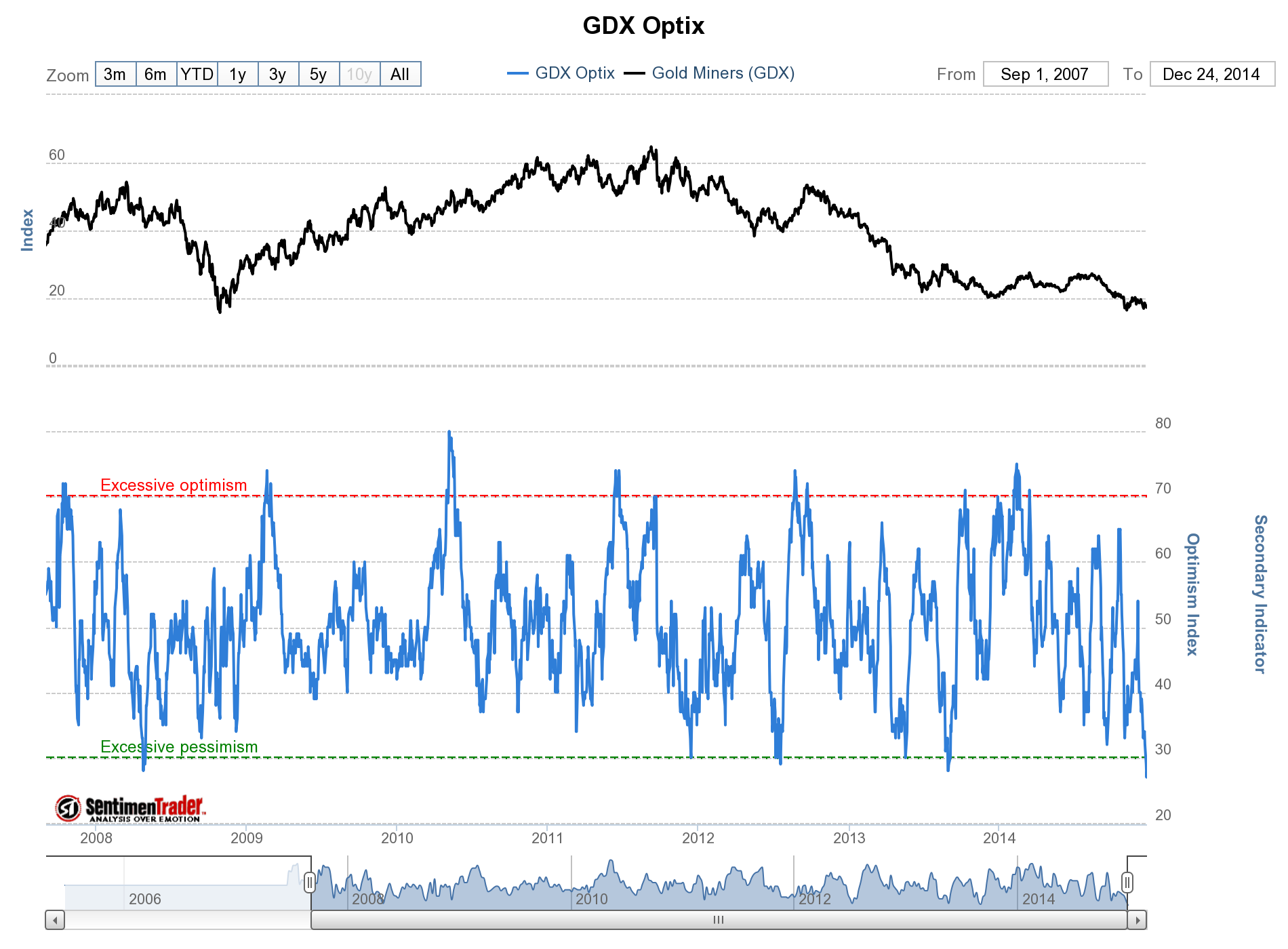
The following sentiment indicator was developed by sentimentrader.com. For various ETFs it considers options activity, fund flows, the discount to NAV and future volatility expectations. Like any indicator, it is only a single indicator and is best used in conjunction with other indicators. Interestingly, the Optix for GDX touched 27% two days ago. That is the lowest since GDX began trading in 2006.

dec25edgdxsent


Breadth indicators also indicate an extreme oversold condition in the miners. The bullish percentage index (% of stocks on a P&F buy signal) for the GDM index (forerunner to GDX) is currently at only 3% but was at 0% at last weeks low. It has only ticked 0% a handful of times in the past two years. Second, the percentage of stocks in the HUI trading above their 200-day moving average is currently 6% but was 0% at last weeks low. The last time both indicators were at 0% together (as they were last week) was in late 2008.
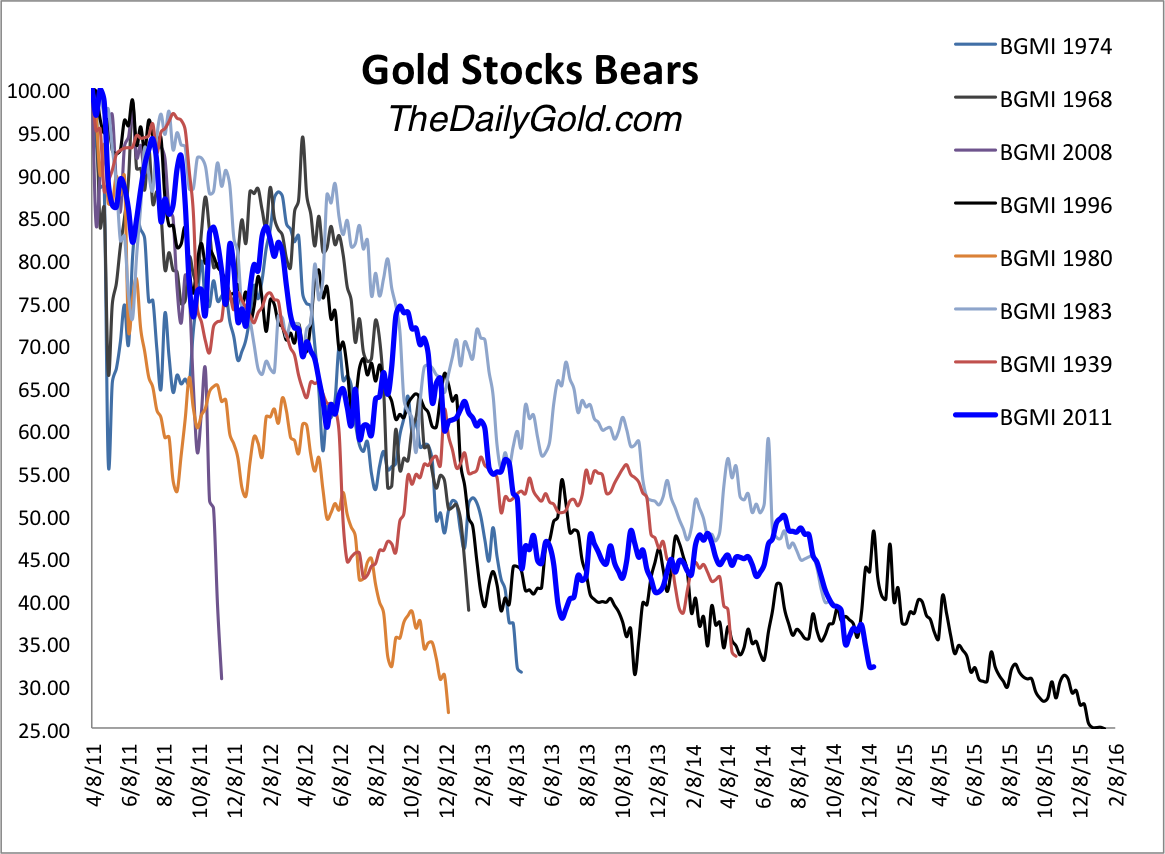
Here is a look at the updated bear analogs for the gold stocks. We use the Barron’s Gold Mining Index as it has the longest history. The current bear is in line with the 1996-2000 bear. After declining 69% over two and a half years that bear mounted a rebound that lasted over a year. That was followed by a decline to new lows. The current bear is down 68% and at this point on the scale is in the worst shape relative to all the other bears.

dec19bgmibears

For further comparison to the 1996-2000 bear, consider the figures for the other indices. Then the XAU declined 73%. At its recent low it was down 73%. Then the HUI declined 83%. It’s been down as much as 77% in this bear. The GDM index has lost 75% in this bear market and 77% in the 1996-2000 bear market. Meanwhile, GDXJ has lost up to 86% in the current bear market.
As we noted last week, the miners appear to be holding their November low and have a tradeable setup. The HUI is trading between 155 and 175 while GDX is trading between 17 and 20. A short-term rally to resistance is definitely possible. Given the current extreme oversold condition, are the miners ready to rebound through resistance and rally the way they did last January? On the other hand, will the metals cooperate? After 2013 tax loss selling, GDXJ rebounded over 50% within two months. We are working hard to prepare subscribers for this opportunity. Consider learning more about our premium service which includes a report on our top 5 stocks to buy.

Good Luck!

Jordan Roy-Byrne, CMT